


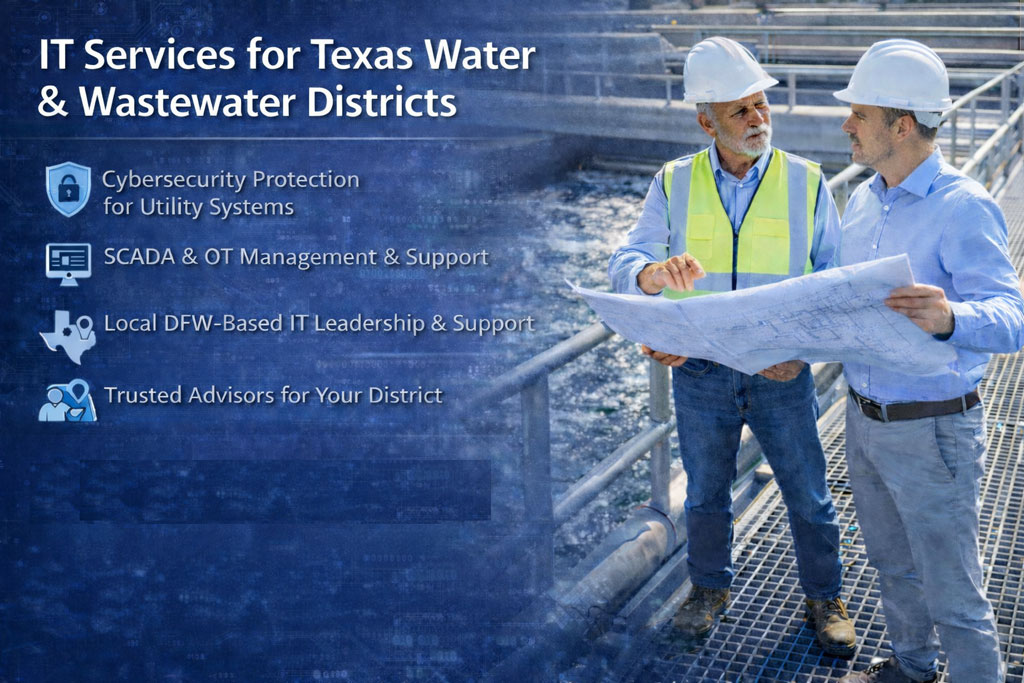
Why This Matters
Water and wastewater districts in Texas operate essential public infrastructure under increasing pressure. Aging systems, limited staff, cybersecurity threats, regulatory oversight, and population growth all converge on technology—whether planned or not.
This page explains how managed IT services support Texas water and wastewater districts, why technology risk is now an executive responsibility, and how Fulcrum Group helps district leaders maintain operational continuity, public trust, and accountability across the DFW Metroplex and beyond.
The Problem / Reality Check
Most water and wastewater districts were not designed to be technology organizations—yet today, operations depend on IT systems, connectivity, and data integrity.
Common challenges we see across Texas districts include:
- Aging infrastructure paired with modern digital controls
- SCADA, PLCs, and remote access systems increasing cyber exposure
- Workforce retirements and loss of institutional knowledge
- Limited internal IT resources and budget constraints
- Rising expectations from regulators, boards, and the public
Technology failures in a utility environment do not stay isolated. They impact water delivery, compliance, public confidence, and leadership accountability. Hence, they are considered critical infrastructure.
CISA Guidance
Fortunately, the government agency Cybersecurity and Infrastructure Security Agency (CISA) has helped provide some tips to help agencies protect themselves from the ever increasing number of threats and ever their increasing sophistication. Here is our quick summary of some of their suggestions.
- Understand your technology baseline
Maintain a clear inventory of systems, software, connections, and risks (including third-party)—especially where IT and SCADA/OT intersect. - Separate IT and operational systems
Segment business networks from control systems to limit the impact of a breach. Physical separation across different devices is best, but some organizations may befinancially constrained and settle for logical separation. - Limit and secure remote access

Reduce exposed remote connections, monitor vendor access, and remove unnecessary entry points. Replace legacy firewall-based VPN solutions with modern zero-trust tools for more secure access. - Control who has access to what
Enforce strong identity and access management with unique accounts and least-privilege permissions. Look for solutions that support Microsoft identity-based integration and MFA support. - Prepare for incidents in advance
Establish and practice an incident response plan covering technical actions, leadership roles, and communications. Use DIR and other sample tabletop exercises to help you prepare for what could be the worst. - Protect and test backups
Maintain secure, offline backups and regularly test restoration to ensure recovery is possible. Improving login security, using immutable storage, and cloud-based secondary backups can be lifesavers. - Use available federal cybersecurity services to complement us
Take advantage of free CISA services such as assessments, vulnerability scanning, and incident assistance. We can assist with information to complete applications for any free services, as part of our relationship.
The Fulcrum Way:
Fulcrum Group supports water and wastewater districts using a governance-first, prevention-focused approach aligned to how public entities actually operate.
Our work is grounded in:
- SPOT Managed IT Services as the operational foundation and possibly add on additional cybersecurity capabilities
- The STARpower Framework, focusing on stability, transparency, accountability, and resilience
- A No IT Jerks philosophy—clear communication, respect for public service, and realistic recommendations
- Texas-based, non-outsourced support that understands local utility realities
- Practical solutions sized for districts—not enterprise complexity
We focus on reducing risk, improving visibility, and supporting leadership decision-making—not selling tools for their own sake.
What’s Included
Fulcrum’s support for water and wastewater districts commonly includes:
- Managed IT services designed for public sector accountability
- Cybersecurity risk management offerings aligned to utility operations
- Working with your existing vendors to improve SCADA and operational technology boundary protection support
- Backup, disaster recovery, and incident readiness planning
- Identity, access, and endpoint management
- Vendor coordination and technology oversight
- Executive-level reporting for boards and leadership
Every engagement is scoped to the district’s size, risk profile, and operational priorities.
Real-World Context / Proof
Across North Texas and statewide, districts are experiencing:
- Increased cyber targeting of operational systems requiring security improvements
- Greater scrutiny of incident preparedness and response
- Difficulty replacing retiring staff with equivalent experience
- Technology decisions moving from “IT issues” to board-level discussions
- A huge amount of ICS system vulnerability advisories, requiring organizational action
Districts that proactively manage IT and cybersecurity reduce service disruption, improve audit readiness, and maintain public confidence—without overextending budgets or staff.
Why Fulcrum Group
Fulcrum Group is based in Keller, Texas and serves organizations across the DFW Metroplex and statewide. We understand the operational, regulatory, and leadership realities of water and wastewater districts.
Clients work with Fulcrum because we:
- Speak in executive, not technical, language
- Prioritize risk reduction and continuity
- Provide consistent, local support
- Align technology decisions to governance and public trust
If you’re responsible for technology oversight in a water or wastewater district and want a clearer view of risk, readiness, and next steps, call and schedule a practical discussion with Fulcrum Group to review your current environment 817-337-0300.
Or, click the link at the side to send a more detailed question to our team and request a meeting.
Frequently Asked Questions
1. Why do water and wastewater districts need managed IT services?
Because operations heavily depend on technology and automation to support limited manpower. Managed IT helps districts reduce risk, maintain continuity, and support leadership accountability.
2. Is cybersecurity really a concern for small or rural districts?
Yes. Smaller districts are often targeted because they have fewer protections and limited internal resources. Smaller organizations benefit from having the additional technical and strategic leaders to supplement their team in providing water resilience.
3. How does IT impact SCADA and operational systems?
While SCADA systems remain specialized, IT networks, access controls, backups, and monitoring directly affect their security and reliability. As SCADA evolves into more Internet of Things (IoT) devices and uses more cloud computing, operational needs change and require more modern approaches and technologies.
4. What role should the board play in IT and cybersecurity?
Boards provide oversight—setting expectations for risk management, preparedness, and accountability without managing technical details. That vision and leadership is required to hold yourself accountable to ask the right questions and ensure proper security and ongoing vigilance.
5. Can Fulcrum work with existing vendors and engineers?
Yes. We coordinate with engineers, SCADA vendors, and regulators as part of a broader governance approach. We are definitely not experts at specific SCADA systems, simply experienced in working with different SCADA vendors and integrating them as part of a larger plan and strategy, like a general contractor working with individual specialists.
6. How is Fulcrum different from a generic IT provider?
We specialize in accountable, public-sector environments and focus on prevention, clarity, and leadership support—not reactive ticket handling. We are constantly researching and reading the trends in the government space. One of our fractional CIOs spends most of his time with government and municipality-type organizations, understanding their unique requirements and needs We also hold managed services contracts with the DIR and an AI contract with the North Central Texas Council of Governments, to ease doing business with us as a “best value”.