


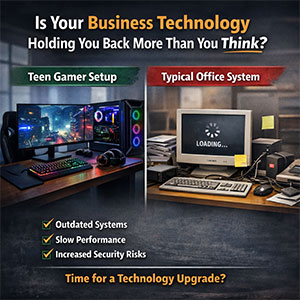
Is Your Business Technology Holding You Back More Than You Think?
Many of us grew up blowing into Nintendo cartridges and tapping the console to make games work. That was our version of IT support. Today, the gaming setup in a teenager’s bedroom is often better maintained, more secure and more optimized than the technology many North Texas organizations rely on every day. Gaming systems are updated, monitored and tuned intentionally. Business systems often lag behind because they have grown gradually, not strategically.
Why Gamers Stay Ahead
The difference is not budget. A capable gaming computer costs about the same as a business workstation. Business internet is often faster than residential service. The tools needed to monitor and protect business networks are accessible and affordable. What separates the two is attention. Gamers update software immediately, monitor performance continuously and maintain backups because performance matters. In many offices, updates are postponed, backups are assumed and problems are noticed only when an employee reports something is slow.
How Business Systems Become Complicated
Office environments are rarely designed all at once. Tools are added over time to solve specific needs. A new accounting system here, a CRM there, a file sharing tool added later. Each addition made sense at the time, but over several years technology shifts from being designed to being accumulated. Accumulated systems create friction, and that friction shows up as slow performance, inconsistent workflows and increased vulnerabilities.
The Hidden Cost of Tolerating Inefficiency
Most businesses experience delays that feel minor in the moment: slow logins, repeated reboots, searching for misplaced files or switching between tools that do not integrate. These interruptions feel small, but research shows it takes significant time to refocus after each disruption. Spread across a team, the untracked costs add up to thousands of lost hours each year. In gaming, lag is unacceptable. In many offices, lag becomes routine. Over time, routine inefficiency becomes expensive.
A Better Way to Think About Your Technology
When business owners are asked about their technology, the common answer is that it works fine. Working and working efficiently are not the same. Effective systems are integrated, monitored and maintained intentionally. Modern productivity depends on software, security layers, automation and workflows that support the way your organization operates. None of these improve on their own, and avoiding issues requires intentional oversight.
A Quick Self‑Assessment
- Do you know when your oldest office computer was purchased?
- Do you know whether your backups ran successfully last week?
- Is there a device on your network with a pending update that has been ignored for more than a week?
- Could you identify your office internet speed without looking it up?
If these questions are difficult to answer, that does not indicate failure. It simply means no one has been responsible for this level of oversight. That is a solvable issue.
Where We Can Help
We help North Texas organizations move from accumulated technology to optimized technology. Our approach begins with understanding your systems, identifying what is outdated, eliminating unnecessary tools and improving the workflows your team relies on daily. The focus is not more technology. The focus is better technology that supports productivity, security and long‑term stability.
Call us at 817-337-0300 or Book your 10-minute discovery call here: https://www.fulcrumgroup.net/discoverycall/
If this brings another business owner to mind, feel free to pass it along. Reducing the lag in your technology environment often starts with a simple conversation.