


Somewhere in Tarrant County right now, a finance lead is building the 2027 budget. The IT line is last year’s number with a few percent added, because that is what you do when nothing obviously broke.
It is a defensible way to budget. It is also the reason that in about seven months, somebody is going to walk into that person’s office holding an invoice nobody planned for.
Surprise technology expenses are rarely surprises. They are predictable months ahead of the invoice, and almost always visible to someone — just not to the person approving the budget. Here are the four places the gap opens, and what closes it.
First, the number you shouldn’t copy
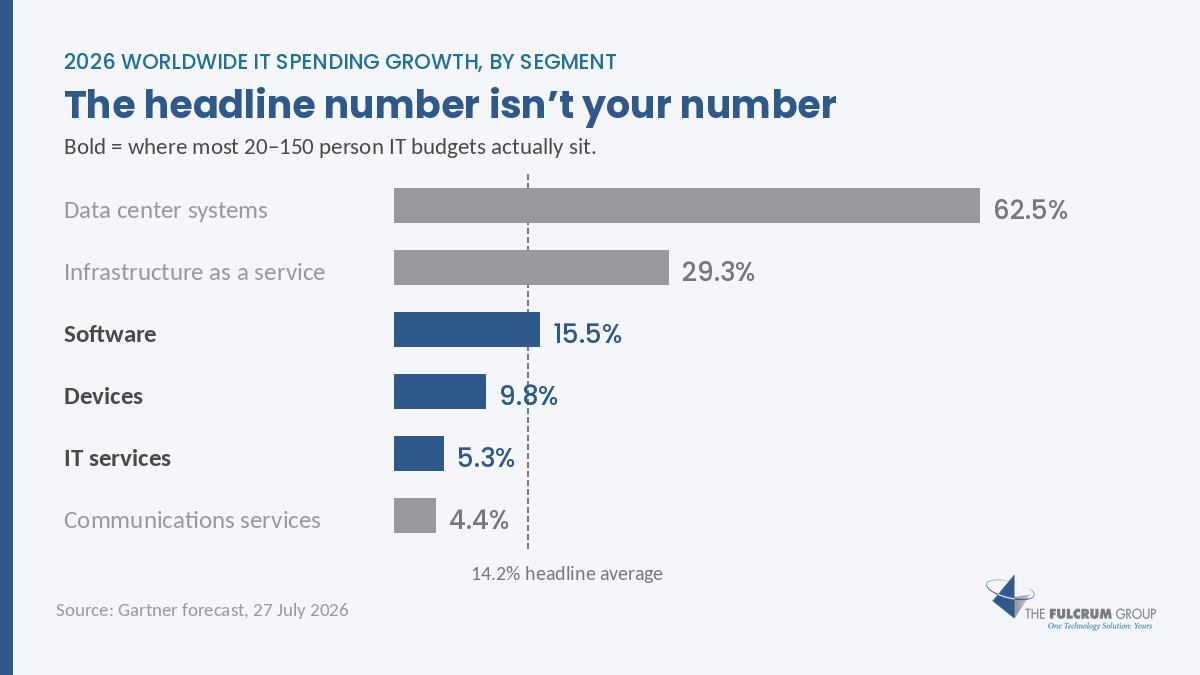
You will see a headline this quarter saying worldwide IT spending is growing double digits. Gartner’s July 2026 forecast puts 2026 at $6.37 trillion, up 14.2%.
Do not take that number into your budget meeting. It is wildly skewed by one segment: data center systems, growing 62.5% on AI infrastructure most small businesses will never buy directly. A 60-person firm in Keller is not spending like a hyperscaler.
The number that is yours is further down the same table: software, up 15.5%. Devices, up 9.8%. IT services, up 5.3%.
That matters because of where your money actually sits. For most 20-to-150 person organizations, the IT budget is mostly recurring software and licensing, a hardware refresh, and a services agreement. Two of those three are rising faster than the inflation figure you probably penciled in — and software, the largest share, is rising fastest.
So “last year plus three percent” isn’t conservative. On the biggest line in the budget, it is a reduction.
Mistake 1 — Budgeting from the rearview mirror
Last year’s spend tells you what you bought. It tells you nothing about what is about to come due.
A useful budget is built from a forward list, not a backward one. Four inputs produce it:
- Every renewal date in the next 18 months, with the current price and the renewal price if you know it
- Age of every machine, with the ones crossing five years flagged
- Headcount plan — each new person is a laptop, a license bundle, and a phone
- Anything the business plans to do that touches systems: a new location, an acquisition, a line-of-business application, a compliance requirement
None of that is exotic. All of it is knowable in an afternoon. Almost nobody assembles it before the budget is locked.
Mistake 2 — “It still works” as a replacement strategy
The honest version of this sentence is: it still works, and when it stops, we will spend whatever it costs to fix it that day. That is not a strategy, it is a deferral with interest.
The cleanest live example is Windows 10. Support ended October 14, 2025. For machines that couldn’t move to Windows 11, Microsoft offered Extended Security Updates, and Microsoft’s own documentation spells out the terms plainly:
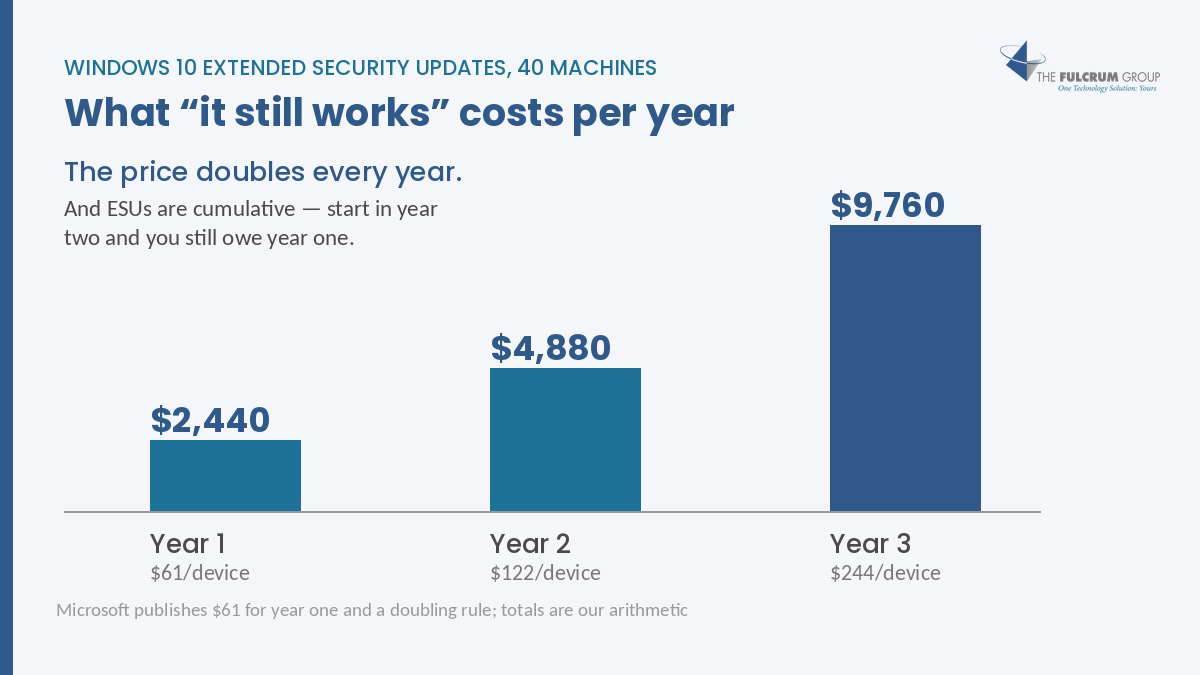
- $61 per device for year one through volume licensing
- the price doubles every consecutive year, for a maximum of three years
- ESUs are cumulative — start in year two and you must also buy year one
Run that for a 40-machine office. Year one is about $2,440. Year two, at double, is roughly $4,880 — and a business that skipped year one and tries to start in year two owes both. (That arithmetic is ours; Microsoft publishes the $61 and the doubling rule, not the later-year totals.)
Now compare it to the thing it was avoiding. You are paying an escalating fee, on machines that are getting older anyway, for security updates alone — no new capability, no performance, nothing an employee would notice except the absence of a problem.
The point isn’t Windows 10 specifically. It is that “it still works” has a price, the price is usually published somewhere, and nobody looks it up until the renewal notice lands.
Mistake 3 — Renewals on autopilot
Auto-renew is in nearly every technology contract you hold, and it is genuinely useful. It also means a subscription outlives the reason you bought it, the person who championed it, and sometimes the employee it was licensed for.
Two questions settle most of it:
Who is actually using this? Not who has a license — who opened it last month. Most platforms will tell you. The gap between seats purchased and seats used is, in our experience, the single most reliable place to find money in an SMB technology budget.
What does it renew at? First-year pricing and renewal pricing are frequently different numbers, and the difference shows up on an invoice eleven months after anyone was paying attention.
The fix is unglamorous: put every renewal date on one calendar, with a reminder 60 days ahead — enough time to actually cancel, since most agreements require notice. Review the list before the auto-renew date, not after.
Mistake 4 — The growth plan and the IT budget have never met
One meeting in December decides where the business is going next year. A different meeting, usually later and usually smaller, decides what gets spent on technology. The two rarely reference each other.
So the budget funds the company you were. Then in March somebody adds a location, or hires eight people, or signs a customer whose contract has security requirements attached — and the technology to support it arrives as an unbudgeted request, which is the worst possible framing for a sensible expense.
Bringing these together doesn’t require a new process. It requires the person who understands the technology to be in the room for twenty minutes of the growth conversation, once a year.
The Texas part — and something that genuinely changed this year
Here is the piece you will not find in anyone else’s year-end budget article, and it is worth real money to a DFW business.
Texas taxes business personal property. Under Tax Code §22.01, you must render for taxation the tangible personal property you own and use to produce income as of January 1 — and that includes computers, servers, network gear, phones, furniture and fixtures. The Comptroller’s reminder each spring names it directly: “furniture and fixtures, machinery, equipment and other property owned or managed as of Jan. 1 each year.”
The threshold changed on January 1, 2026. Texas voters approved Proposition 9 in November 2025, and the implementing legislation — H.B. 9, 89th Legislature — raised the exemption in Tax Code §11.145 to $125,000 of appraised value of income-producing tangible personal property, per location, per taxing unit. The old figure was $2,500.
That is a fifty-fold increase, and it has two practical consequences most owners haven’t absorbed yet:
A lot of DFW businesses just became exempt and don’t know it. If everything at your location appraises under $125,000, you are below the line. §22.01 now says you are required to render only if the value exceeds the exempted amount — and §22.01(j-3) lets you file a one-time certification electing not to render, which stays in effect until ownership changes.
If you’re above the line, dead equipment still counts. Ownership on January 1 is what triggers it. Decommissioned servers in a closet, laptops from departed employees, the phone system you replaced in August but never disposed of — if you still own it on January 1, it is still yours to render.
The deadline is April 15, extendable to May 15 on written request under §22.23, with a further 15 days for good cause. Miss it and §22.28 imposes a penalty of 10 percent of the total taxes on that property for the year. File something false and §22.29 adds 50 percent on top, and the rendition form itself carries a bold warning that a false statement can be a Class A misdemeanor or a state jail felony.
So the year-end action item is concrete: decide what you are disposing of, and actually dispose of it before December 31 — properly wiped and documented, not stacked in a closet. Then confirm with your accountant whether you are now under the $125,000 line, because the answer may have changed this year even though nothing about your equipment did.
We’re an IT firm, not a law firm or a tax firm. Confirm the specifics with your CPA and your appraisal district.
While you’re looking at December 31
The other deadline worth knowing is the federal one. For tax years beginning in 2026, IRS Rev. Proc. 2025-32 sets the Section 179 expensing limit at $2,560,000, with the phase-out beginning at $4,090,000 of property placed in service.
For almost every business reading this, the cap is not the constraint — you are nowhere near $2.56 million in equipment. The constraint is the phrase placed in service. Equipment ordered in December but sitting in a box in January generally doesn’t count for the earlier year. If a refresh is going to happen anyway and the timing is genuinely flexible, that distinction is worth a conversation with your CPA in November, not on December 28.
Buying hardware you don’t need in order to save tax remains a bad trade. Timing hardware you were already buying is just good planning.
What a budget without surprises looks like
Four things are true of it, and none of them require new software:
- Every renewal in the next 18 months is on one list, with current price, renewal price and notice period.
- Every machine has an age and a planned replacement year — so refresh is a line item, not an emergency.
- The growth plan has been read by someone technical, and the budget reflects it.
- Someone owns the review, on a schedule, not only when a renewal surprises everyone.
That is the thinking behind Fulcrum’s First Look — an outside read of what you own, what it costs and what is coming due — and then STARMap, our word for the technology roadmap that puts replacement and renewal on a calendar you can budget against. It is the same idea running through our managed IT services and managed security work: the spending is rarely the problem. The not-knowing is. Cheap IT saves cents. Smart IT makes dollars, and a fair amount of the money here is already on your invoice.
Two things to do this week
Ask for the renewal list. Every technology subscription and contract, with its renewal date, current cost and renewal cost. If your provider produces it quickly, that tells you something good about how your account is being managed. If it takes two weeks, that tells you something too.
Ask what you still own that you no longer use. Then get it off the books before January 1. It is a tax question, a security question, and a tidiness question all at once, and it has a hard deadline.
Where this usually goes sideways
The common failure is treating the budget as a number rather than a list. A number can only be defended or attacked. A list can be discussed, sequenced and cut on purpose.
The second failure is building the list once and never revisiting it. Renewal dates move, projects slip, people get hired. A budget reviewed quarterly stays roughly true. One reviewed annually is fiction by March.
The right IT budget can’t predict the future. It can give you the fewest chances to say I didn’t see that one coming.
Want to see what’s actually coming due?
Book a First Look and we’ll map your renewals, your hardware ages and what’s heading for 2027 — a clear picture, with no products to buy at the end of it.
Call 817-337-0300, email sales@fulcrumgroup.net, or start with the podcast — Talk To Th3 Doc — if you’d rather listen before you talk. More like this on the blog.
The Fulcrum Group · Keller, Texas since 2002 · fulcrumgroup.net
Sources
- Gartner, Forecasts Worldwide IT Spending to Grow 14.2% in 2026, press release dated July 27, 2026 — $6.37 trillion total; data center systems +62.5%, software +15.5%, devices +9.8%, IT services +5.3%. Accessed October 2026.
- Microsoft Learn, Extended Security Updates (ESU) program for Windows 10 — $61 per device year one via volume licensing; price doubles every consecutive year to a maximum of three; ESUs are cumulative. End of support October 14, 2025. Accessed October 2026.
- Texas Tax Code §11.145, as amended by Acts 2025, 89th Leg., R.S., Ch. 334 (H.B. 9), Sec. 1, effective January 1, 2026 — $125,000 exemption for income-producing tangible personal property per location per taxing unit. Implements Proposition 9, approved by Texas voters November 2025.
- Texas Tax Code §§22.01, 22.23, 22.24, 22.28, 22.29 — January 1 ownership date; April 15 filing deadline with extension to May 15; 10% penalty for failure to timely render; 50% additional penalty for fraud or intent to evade; Class A misdemeanor / state jail felony warning required on the form.
- Texas Comptroller, Texas Businesses: April 15 is Deadline for Filing Property Tax Renditions, April 8, 2026.
- IRS, Rev. Proc. 2025-32, §4.24 — 2026 Section 179 expensing limit $2,560,000; phase-out threshold $4,090,000.

