



By Steve “The Doctor” Meek | Talk To Th3 Doc Podcast | The Fulcrum Group, Inc.
🎙️Doctor’s Diagnosis: A Podcast Doc-umentary: Leadership, Buy-In, and Change Agency Episode 138
Phil McShan joined me recently on Talk To Th3 Doc, I absolutely loved how he put plain words around something I finally realized a long time ago. He said every leader is in sales. Not the slick, used-car-lot kind (anyone remember Herb Tarlek).
I mean the daily work of selling the company culture why, the direction, the discipline, and the belief that the plan is worth following. That idea lands especially hard in technology, because I have seen plenty of organizations over the years buy the right tools and still trip over their own shoelaces when leadership never sold the reason behind the change.
Introduction – Lead with Why
At Fulcrum, we don’t believe technology should be a pile of blinking lights and invoices that somehow turns into progress by magic. We believe leaders must own their vision, the priorities, and the business context. Sure, our STARPower process helps leaders imagine. But our team is there to bring the framework, the operational discipline, and the technical horsepower to help that vision become real through our Professional Services team. That is why this episode mattered to me. Phil was talking about leadership, but I kept hearing the same truth we see in DFW managed IT services every day, if leaders do not communicate the why, even good strategy gets stuck in the mud.
At The Fulcrum Group, that is wrapped up in the tagline I crafted my first year in business:
“One Technology Solution: Yours.”
I have to keep selling that mission, because it is easy in our industry to fall in love with forcing everybody into the same neat little box and calling it best practice. But that has never been my heart. We are not trying to make clients fit our version of technology. We are trying to shape technology so it fits their business, supports their people, and helps them carry out their mission with a little more clarity and a lot less friction. Of course, that also means we have to ask a lot of questions to understand how each organization is different.
The Problem or Question – Why Do Good Plans Stall Out?
A lot of SMB leaders think their problem is technology. A key takeaway in my recent readings from Microsoft about adoption in general is that people find it hard to change and sometimes the team doesn’t buy into the reason for change, the process for change, or the discipline required to stick with it when the first bump shows up.
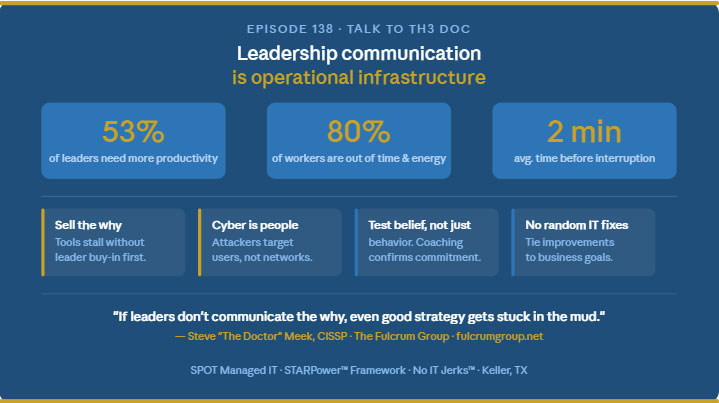
That problem is not getting smaller. Microsoft reported in its 2025 Work Trend Index that 53 percent of leaders said productivity must increase, while 80 percent of the global workforce said they lacked the time or energy to do their work. That is a leadership challenge as much as a staffing challenge, because overloaded teams do not need more slogans, they need clearer priorities and better communication. McKinsey also found that transformations are far more likely to outperform when organizations build employee “will,” not just a project plan.
That is why I also liked Phil’s line that leaders are “constantly selling belief and strategy.” He was not being poetic for sport, he was naming our real work. In business, culture, and IT, leaders must help people understand what is changing, why it matters, and how success will look on the other side. Otherwise, you get what I would call the Nate Bargatze version of digital transformation, that’s where you keep doing a bunch of stuff but seem to be getting the silent treatment.
Side note: Nate has this great joke about watching The Sixth Sense with his wife, and the fact that Bruce Willis was dead is the biggest surprise we’ve seen as men in our life because it’s so believable that your spouse could ignore you for two hours of a movie.
The Fulcrum Way – How We Tie Leadership to Technology Results
This is where Fulcrum’s model matters. We are not trying to replace leadership judgment. We are trying to amplify it.
Our STARPower tool has an assessment tool that we use to measure organizations’ technical and operational maturity levels in a review rhythm built around a simple idea, improvements should tie back to business goals, current-state reality, measurable targets, prioritized next steps, and follow-through. That lines up naturally with ITIL v4 continuous improvement thinking and with the more practical lessons from Toyota Kata, where continuous improvement should be a habit, not a one-time project. One of the author’s key ideas was that Toyota’s advantage was not just better tools or isolated fixes, but a repeatable routine for improving (and also for learning). Real progress then comes from reducing noise, improving flow, and keeping strategic work from getting buried under firefighting.
In plain English, we are trying to help clients avoid random acts of improvement.
That means we ask leaders to bring the business context. You know your market, your people, your risk tolerance, your customer expectations, and your industry pressures. We bring ideas we see at other organizations, disruptive technologies, documentation, security insight, planning cadence, and roadmap discipline to help shape the right next moves. Our managed IT services page says it directly, Fulcrum pairs proactive support with strategic planning and STARPower-based fCIO guidance to help leadership make smarter technology decisions. That is not accidental wording. It is how co-creation actually works and a key component of SPOT Managed IT services.
It also shows up in cybersecurity. Our managed security messaging emphasizes resilience, compliance, and aligning security decisions with operational realities. That matters because security for small business is not just a technology problem. Threat actors used to prioritize attacking networks and technologies but now attackers target end users. This makes cyber security a leadership problem requiring salesmanship. Somebody has to get in front of their busy employees and remind them of the importance of:
- password hygiene
- MFA everywhere
- using security tools that sometimes slow them down
- being mindful of security on non-business networks
- and, taking and learning from their security awareness training
Real-World Example or Metric – What This Looked Like to Me
One of Phil’s strongest ideas was that coaching is not just teaching behavior. It is testing belief. That sounded familiar.
I have seen organizations approve a cloud migration, security initiative, or AI pilot, then quietly almost sabotage it without meaning to. Not because they were foolish, but because no one ever slowed down to confirm whether managers believed the change would work, knew how to reinforce it, or had the time to coach people through it. That is the part many vendors skip because it is easier to sell a tool than to help a leader be a change agent and carry a message.
The market data backs up that concern. Microsoft’s 2025 research found employees are interrupted by meetings, emails, or pings on average every two minutes, which helps explain why attention and consistency feel so scarce right now. Gallup’s 2025 workplace research also continued to show that employee engagement and manager quality are tightly connected, and that low engagement is expensive in lost productivity and performance. When you put those pieces together, the case gets pretty simple, leadership communication is no longer soft stuff. It is operational infrastructure.
That is one reason Fulcrum likes structure. We use frameworks, process, documentation, review cadences, and measurable priorities because “everybody just try harder” is not a strategy. That is a pep talk wearing boots two sizes too big.
Key Takeaways / FAQ
Why does “selling the why” matter in IT?
Because tools do not create adoption by themselves. Leaders have to connect the change to business value, risk reduction, and day-to-day reality.
What does Fulcrum do differently here?
We combine DFW managed IT services, cybersecurity discipline, and quarterly STARPower planning so technology decisions stay tied to vision, priorities, and measurable progress.
How does this connect to SPOT Managed IT Services?
SPOT is not just “help desk” support. It includes strategic planning, documentation, monitoring, and improvement guidance that helps leaders move from reactive mode to intentional execution.
Where does AI fit into this conversation?
AI can speed work, improve analysis, and reduce repetitive tasks, but only if leaders guide use cases clearly and keep humans in the loop. Fulcrum’s AI and automation services are built for that kind of practical adoption.
What is one warning sign a leadership team is drifting?
When the same priority keeps getting discussed, but nobody can explain why it matters or what success looks like.
What is the plainspoken takeaway?
If your team is confused, your tools will look dumber than they are. That is not always the tool’s fault.
Call to Action
If you missed Episode 138, I think it is worth your time. Phil helped put language around a problem many business owners and managers feel every day, strategy does not stick unless leaders help people believe in it. And from the Fulcrum side, I would add this, your technology roadmap will not stick either unless leadership owns the why and keeps showing up with a clear message of why.
Watch or listen to Talk To Th3 Doc on your platform of choice, and if your organization needs a partner that can help connect leadership priorities to secure, practical execution, connect with The Fulcrum Group for a strategy conversation. We serve SMBs, local governments, and mission-driven organizations across North Texas with a Texas-based team, structured planning, cybersecurity depth, and a firm belief that you deserve No IT Jerks and no mystery novel billing either.
About the Author — Steve “The Doctor” Meek, CISSP
Steve “The Doctor” Meek is a DFW-based IT strategist, cybersecurity leader, podcast host, and co-founder of a 24-year technology legacy in North Texas. A recipient of the 2024 MSP Titan of Industry Award for Community Impact, Steve brings decades of experience helping CEOs, city managers, and healthcare and manufacturing leaders navigate cybersecurity, AI readiness, and operational resilience. As host of Talk To Th3 Doc, he explores leadership and ownership topics to find practical insights for SMB decision-makers.
Founded in Keller, TX, The Fulcrum Group, Inc. delivers relationship-centered DFW Managed IT Services through its flagship SPOT Managed IT Services and SPOT Managed Security Services platforms. Using its proprietary STARPower™ Framework, Fulcrum helps businesses strengthen security, modernize operations, and plan technology with clarity and confidence. With a 100% Texas-based team and a “No IT Jerks” philosophy, Fulcrum has earned repeated national recognition on the MSP 501 and CRN Top 500, serving SMBs, local governments, and mission-driven organizations across North Texas.

