


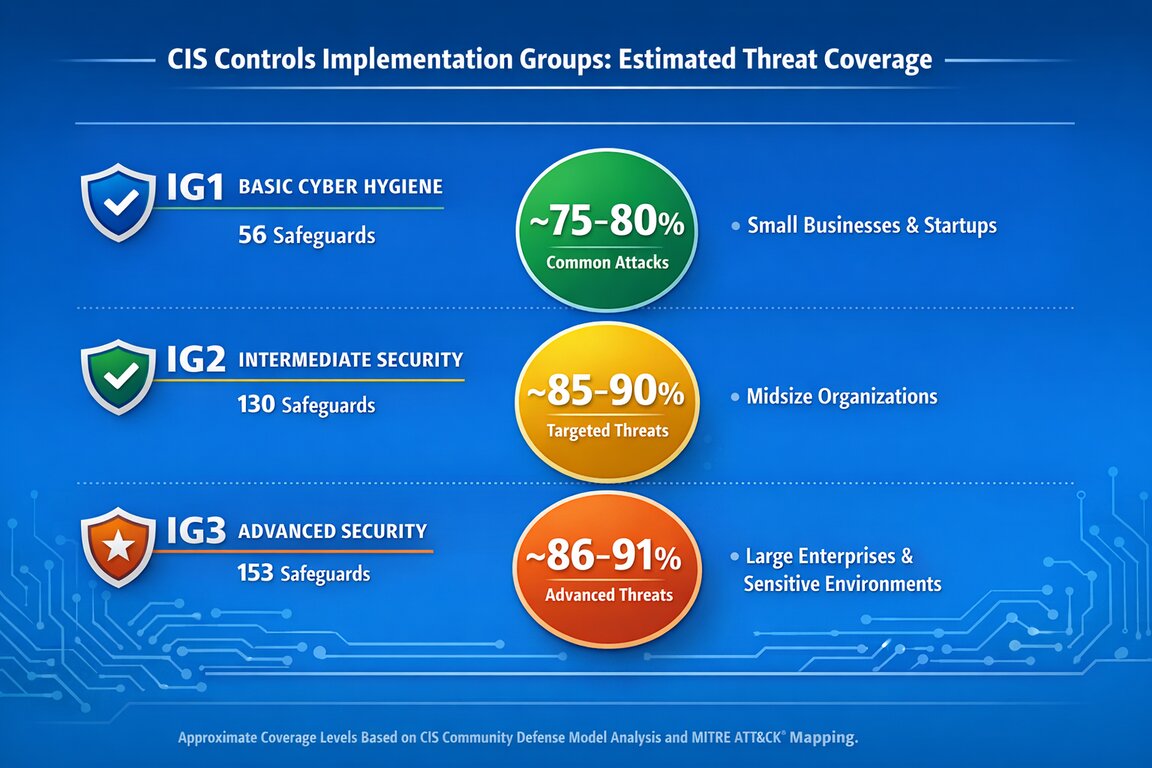
The CIS Critical Security Controls are a prioritized list of 18 cybersecurity practices from the Center for Internet Security. For a small business, the place to start is Implementation Group 1 (IG1), 56 basic safeguards CIS calls essential cyber hygiene. In Texas, following them can also help qualify a business for the state’s cybersecurity safe harbor.
Most security frameworks were written for big companies with dedicated security teams. The CIS Controls are different. They’re specific, they’re ranked by what matters most and the first tier is designed for organizations with limited IT staff. That makes them one of the most practical roadmaps a small business, nonprofit or local government in North Texas can use. Here’s what they are in plain English, where to start and why they matter more in Texas since 2025.
What are the CIS Controls?
The CIS Critical Security Controls are a set of recommended security practices maintained by the Center for Internet Security, a nonprofit. The current version, v8.1, organizes them into 18 controls, each broken into specific actions called safeguards. They focus on the attacks that actually happen most often, not every theoretical risk.
What are the 18 CIS Controls?
| # | Control | In plain English |
|---|---|---|
| 1 | Inventory of enterprise assets | Know every device on your network |
| 2 | Inventory of software assets | Know what software is installed and allowed |
| 3 | Data protection | Know where sensitive data lives and protect it |
| 4 | Secure configuration | Change risky defaults on devices and software |
| 5 | Account management | Create, review and remove accounts properly |
| 6 | Access control management | Give people only the access they need, with MFA |
| 7 | Continuous vulnerability management | Patch and fix weaknesses on a schedule |
| 8 | Audit log management | Keep and review logs so you can investigate |
| 9 | Email and web browser protections | Filter dangerous email and websites |
| 10 | Malware defenses | Run modern anti-malware on every device |
| 11 | Data recovery | Back up data and test that you can restore it |
| 12 | Network infrastructure management | Keep firewalls, switches and Wi-Fi secure and updated |
| 13 | Network monitoring and defense | Watch for and respond to suspicious traffic |
| 14 | Security awareness training | Train people to spot and report threats |
| 15 | Service provider management | Vet and oversee vendors who touch your data |
| 16 | Application software security | Build or buy software with security in mind |
| 17 | Incident response management | Have a plan and practice it |
| 18 | Penetration testing | Have experts test your defenses |
What are the CIS Implementation Groups?
Not every organization needs every safeguard on day one. CIS sorts them into three Implementation Groups:
- IG1: 56 foundational safeguards. CIS describes IG1 as “essential cyber hygiene” and says a typical IG1 organization is small to medium-sized “with limited IT and cybersecurity expertise.”
- IG2: adds safeguards for organizations with more complex environments, sensitive data or regulatory obligations.
- IG3: adds advanced safeguards for organizations facing sophisticated, targeted attackers.
Most businesses with 20 to 150 employees should aim to complete IG1 first, then pick up IG2 safeguards that match their risks, such as stronger logging for a healthcare practice or a city handling CJIS data.
Where should a small business start with the CIS Controls?
If IG1 feels like a lot, start with the safeguards that stop the most common attacks:
- Know what you have. A current list of devices, software and accounts (Controls 1, 2 and 5).
- Lock down accounts. MFA everywhere, separate admin accounts and prompt removal when people leave (Controls 5 and 6). Our guides to business password policy and choosing the right MFA cover this.
- Patch on a schedule for operating systems, apps and network gear (Controls 7 and 12).
- Back up and test restores with copies attackers can’t reach (Control 11). A tested backup and disaster recovery plan is the safety net for everything else.
- Train your people on a regular cadence (Control 14). See how often employees should get cybersecurity training.
- Write down your incident response plan (Control 17).
How long does it take to implement CIS IG1?
It depends on where you start. An organization that already has Microsoft 365 Business Premium, managed devices and tested backups may close most IG1 gaps in a few months. One starting from scratch should plan on a year of steady work, tackled as quarterly priorities instead of one big project. The goal is progress you can document, not perfection.
What are the most common security misconfigurations?
The NSA and CISA published a joint advisory listing the top ten cybersecurity misconfigurations their red and blue teams find in real networks. They line up closely with the CIS Controls:
- Default configurations of software and applications
- Improper separation of user and administrator privileges
- Insufficient internal network monitoring
- Lack of network segmentation
- Poor patch management
- Bypass of system access controls
- Weak or misconfigured MFA methods
- Insufficient access controls on network shares and services
- Poor credential hygiene
- Unrestricted code execution
That advisory dates to 2023, but the list still reads like a checklist of the gaps most worth checking first. Working through CIS IG1 addresses most of it.
Why do the CIS Controls matter for Texas businesses?
Since September 1, 2025, Texas has offered a cybersecurity safe harbor under Senate Bill 2610. Businesses with fewer than 250 employees that handle sensitive personal information can be protected from exemplary (punitive) damages in a data breach lawsuit if they meet a cybersecurity standard sized to their headcount:
- Fewer than 20 employees: password policies and employee cybersecurity training
- 20 to 99 employees: CIS Controls Implementation Group 1
- 100 to 249 employees: an industry-recognized framework such as NIST, ISO 27001 or the CIS Controls
It doesn’t eliminate liability, and you should talk with your attorney about how it applies to you. But for a lot of DFW businesses, IG1 just became a clear, defensible target rather than an abstract best practice.
Frequently asked questions
What are the CIS Critical Security Controls?
They’re 18 prioritized cybersecurity practices from the Center for Internet Security, broken into specific safeguards. The current version is v8.1, and the controls focus on defending against the most common real-world attacks.
How many CIS Controls are there?
There are 18 controls in version 8.1, containing 153 safeguards in total. Implementation Group 1, the starting point for small organizations, includes 56 of them.
What is CIS IG1?
IG1 is the first Implementation Group, a set of 56 foundational safeguards that CIS calls essential cyber hygiene. It’s designed for small to medium organizations with limited IT and security staff.
Are the CIS Controls required by law?
Not directly for most businesses. But Texas SB 2610 uses CIS IG1 as the standard for businesses with 20 to 99 employees seeking protection from exemplary damages after a breach.
What is the difference between CIS Controls and NIST CSF?
NIST CSF describes security outcomes at a high level. The CIS Controls are more specific and prescriptive about what to do. Many organizations use CIS Controls as the practical way to meet NIST CSF goals.
How The Fulcrum Group helps
We help North Texas organizations turn the CIS Controls into a practical plan. Through SPOT Managed Security Services and SPOT Managed IT Services, that includes assessing where you stand against IG1, prioritizing the gaps, implementing the fixes and keeping documentation current so you can show your work to insurers, auditors and, if it ever comes to it, attorneys. Cities and special districts can learn more on our local government page.
If you’d like to know how your organization measures up, Schedule a Discovery Call.

